Can you mix different brands of solar panel connectors? The short answer is: only when the exact connector models are confirmed compatible. Similar shapes can hide differences in contact geometry, seals, materials, and locking dimensions. A plug that seems to fit may still make a poor electrical connection. That matters on a hot roof, where a loose contact can heat up under load.
John Wiles, a respected photovoltaic electrical-safety educator, focused on careful component selection and verified compatibility. A practical summary of that guidance is: “A connector that fits is not proof that it is a compatible, approved pair.” Treat this as a paraphrase, not a verbatim quotation. Check the connector manufacturers’ instructions, model numbers, voltage and current ratings, and any stated cross-mating approval. If approval is unclear, use matching connectors from the same manufacturer and series, or ask the manufacturers for written confirmation.
Details count. Compare the markings on both connector halves, inspect seals for damage, and confirm the cable size suits the terminals. Do not rely on color, brand reputation, or a firm click alone. Even careful installers can miss a subtle model mismatch; I would not call visual inspection enough. A qualified solar electrician can verify the parts and crimping tools before installation. Small checks matter. Mixing brands may be possible in specific, documented cases, but it should never be assumed safe just because two connectors join.
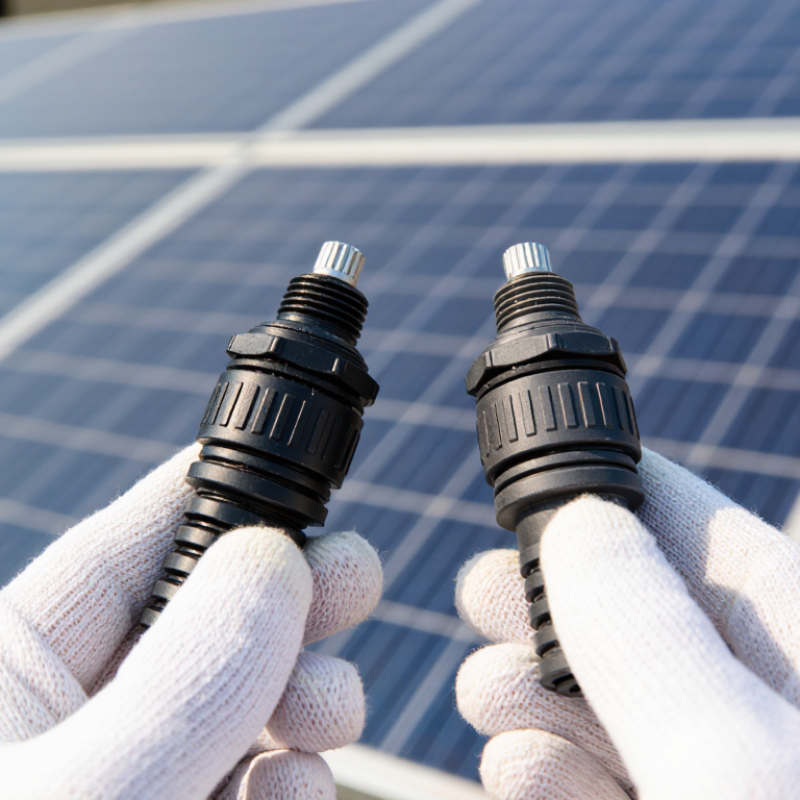
Solar Connector Basics: IEC 62852 Covers Ratings up to 1,500 V DC
IEC 62852 sets safety requirements and test methods for photovoltaic DC connectors rated up to 1,500 V DC. That rating describes a connector’s tested electrical limits; it does not mean every connector with the same rating can safely mate with another. Different housings may look identical while contact geometry, seals, and locking force differ. A poor match can create resistance, heat, or water ingress at a rooftop connection.
The scale makes careful selection important. IEA PVPS’s Snapshot of Global PV Markets 2024 estimated at least 407 GW of new solar capacity in 2023, bringing cumulative global capacity above 1.6 TW. But a large market does not make mixed-brand connections interchangeable. Use connectors specified as compatible by their manufacturers, and check the exact product documentation, cable size, and installation instructions. A voltage label alone is not enough. IEC 62852 compliance is useful evidence, not a universal mating approval.
During installation, inspect the latch and seal, then verify the crimp with the correct tool. Keep dust caps on unused ends; fine grit can be hard to spot. I would not rely on appearance or a quick tug test. Even careful checks have limits, so documenting connector types and following the system designer’s approved parts list can prevent uncertainty during later maintenance.
Brand Compatibility: Why “MC4-Compatible” Does Not Guarantee a Safe Match
“MC4-compatible” describes a connector shape, not a universal promise of safe interchange. Two plugs may click together and still differ in contact geometry, metal thickness, plating, or sealing pressure. A click is not proof. Small differences can raise electrical resistance, creating heat at the joint during sustained current. Water and dust can also enter if seals compress unevenly.
Compatibility depends on the complete connection, not just the visible shell. Check the connector maker’s written compatibility guidance, module and cable specifications, and required crimp contacts and tools. Some parts look nearly identical. They may not be qualified as a pair. Mixing connectors can also complicate troubleshooting: heat may come from a poor crimp, contamination, wear, or mismatched contacts.
For a rooftop array, use matched connector pairs whenever possible. Have a qualified solar technician verify any proposed combination against product documentation. Do not force parts that resist insertion or rely on a hand-pull test alone. Inspect for cracked housings, loose pins, discoloration, and damaged seals. These checks help, but they cannot replace electrical testing. A mixed pair may seem fine at installation; hidden resistance can appear only under load. That uncertainty deserves more attention than the satisfying click.
Electrical Limits: IEC 62852 Covers Connector Ratings up to 125 A
IEC 62852 addresses safety and performance requirements for photovoltaic DC connectors, with rated currents up to 125 A. That figure is a limit within the standard’s scope, not a promise that every connector can carry 125 A. Check the rating printed on the component and its technical datasheet. A small connector rated for 30 A does not become suitable for higher current because another part of the circuit has a larger rating.
Real operating conditions matter. High ambient temperatures, tight cable routing, and undersized conductors can increase heat at a connection. During installation, a technician should verify the connector’s current rating, cable size, voltage rating, and specified assembly method. A loose contact may look normal from the outside. Heat can tell a different story.
Matching electrical ratings alone does not confirm that connectors from different manufacturers can safely mate. Housing dimensions, contact shapes, seals, and tolerances may differ. Use combinations that the connector manufacturers explicitly approve, and follow the system design documentation. I have seen mixed parts appear to fit, which is not the same as proving a reliable connection. That distinction is easy to overlook.
China Best Solar Connectors Can You Mix Different Brands? - Electrical Limits: IEC 62852 Covers Connector Ratings up to 125 A
| Evaluation Dimension |
Standard or Practical Reference |
What It Means When Selecting or Mixing Connectors |
| IEC 62852 scope |
Photovoltaic DC connectors; scope includes rated voltages up to 1,500 V DC and rated currents up to 125 A per contact. |
These are upper limits within the standard’s scope, not ratings that apply to every connector. Check the specific product’s marked ratings and documentation. |
| Rated current |
Connector current ratings vary by model and may be lower than 125 A. |
Use the lowest applicable rating among the connector, cable, and other circuit components. Do not assume two connectors have the same current capacity because they look alike. |
| Rated voltage |
Connector voltage rating must suit the PV system’s maximum DC voltage. |
Confirm the rating for the exact connector model and system configuration. A rating within the IEC 62852 scope does not establish compatibility between different connector designs. |
| Cable compatibility |
IEC 62852 covers PV connectors intended for use with specified conductor sizes; product documentation identifies the supported cable size and type. |
Match the connector to the cable’s conductor size, construction, insulation diameter, and approved assembly method. A mismatch can compromise the termination. |
| Mechanical mating |
Similar appearance or a shared nominal rating does not prove that connector halves are mechanically compatible. |
Use mating halves identified by the manufacturer as compatible. Different designs may differ in dimensions, contact pressure, locking features, or sealing. |
| Cross-brand connection |
IEC 62852 compliance by itself does not certify that connectors from different manufacturers can be mated together. |
Do not mix brands unless the manufacturers explicitly confirm compatibility for the exact connector models and the installation rules permit it. |
| Environmental protection |
Protection depends on the connector design, correct assembly, cable selection, and installation conditions. |
Check the product’s ingress-protection information and installation instructions. An incorrectly mated or assembled pair may not retain its intended protection. |
| Installation and maintenance |
Connector assembly requires the specified tools and procedures. |
Follow the manufacturer’s instructions, use approved crimping tools where required, and replace damaged or incompatible parts rather than forcing a connection. |
| Practical decision |
Confirm model-level ratings, cable suitability, and documented mating compatibility. |
For a reliable PV connection, use a verified matching connector pair. Treat “IEC 62852 compliant” as a safety-standard reference, not as permission to mix connector brands. |
How to Check Compatibility: Match Connector Models, Cables, and Ratings
A connector may click into place and still be incompatible. Matching shapes do not prove matching contact pressure, sealing, or electrical performance. Compare the exact connector model numbers in the manufacturers’ documentation, not just the product photos. Check cable conductor size and insulation diameter; both affect the crimp and seal. A connector intended for one cable range may grip another poorly. It can look seated. That is the tricky part.
Also match voltage, current, and temperature ratings across the connector, cable, and other system components. Confirm polarity, approved crimp tooling, and any stated compatibility between connector models. Similar-looking parts are not automatically tested as a combination. A practical check means reading datasheets and installation instructions, then inspecting the finished connection for a complete lock and undamaged seals. Small details matter.
If documentation is unclear, do not assume the parts are interchangeable; ask the supplier or a qualified solar technician. I would not treat a tight fit as proof. That shortcut can miss problems hidden inside the housing.
Safe Installation: Follow Manufacturer Instructions and Certified Pairings
Safe solar-connector installation begins with the manufacturers’ compatibility instructions, not a similar-looking shape. Different brands may use different contact dimensions, materials, or locking tolerances. A connection can appear secure while making poor electrical contact. That can increase resistance and create localized heating.
A neat click is not proof.
The IEA PVPS Snapshot of Global PV Markets 2024 reports that worldwide cumulative solar capacity passed 1.6 terawatts in 2023. At this scale, small installation details matter across many systems. Use connectors only when their manufacturers explicitly approve the pairing, and confirm the exact product series and cable size. Check that the connector is certified to the applicable PV connector standard, such as IEC 62852; certification alone does not establish compatibility between two brands. Keep mating surfaces clean and dry, seat the lock fully, and use the specified crimping tool. Do not rely on appearance or force a reluctant connection. Even careful installers can overlook a mismatch, so record the connector types and inspect completed joints. When approval is unclear, replace the pair with a documented compatible set.
Conclusion
Can you mix different brands of solar panel connectors? Not safely by relying on appearance or an “MC4-compatible” label alone. Solar connectors are designed and tested as specific mating systems, and small differences in dimensions, materials, seals, or contact design can affect electrical performance and weather resistance. IEC 62852 addresses photovoltaic connectors, with ratings that may reach 1,500 V DC and 125 A, but those limits do not mean every connector with similar specifications can be paired with another.
Before connecting components, check the exact connector models, cable sizes and types, and voltage and current ratings. Confirm that the proposed combination is explicitly approved by the manufacturers and supported by appropriate certification. Follow the installation instructions, including requirements for assembly, crimping, and environmental protection. When compatibility cannot be verified, use connectors specified as a tested pairing rather than mixing parts based on appearance alone.

 Phlox Energy