Lightning can turn a quiet solar afternoon into a costly electrical event. A nearby strike may induce voltage across photovoltaic strings, cables, inverters, batteries, and utility connections. Direct strikes are less common, but their damage can be severe. Indirect surges still deserve serious attention.
So, how does lightning affect grid-tied solar power systems? It can destroy inverter components, trip protective devices, damage monitoring equipment, and interrupt power export. A single surge may leave burn marks near cable terminals or create hidden defects that appear weeks later. Sometimes, nothing looks damaged.
Lightning researcher Dr. Martin A. Uman wrote, “Lightning is a giant spark of electricity.” That simple description explains the danger. Solar arrays provide extensive conductive wiring across rooftops and open spaces. Their long DC and AC cable runs can collect electromagnetic energy from nearby strikes. The utility grid can also carry surge energy toward the inverter.
This guide examines ten practical ways lightning affects grid-tied solar power systems. It considers direct strikes, induced surges, grounding problems, inverter failures, communication losses, and utility-side disturbances. It also discusses surge protective devices, bonding, inspection practices, and system design choices.
Protection is not a single device.
Real installations often reveal gaps between drawings and reality. A missing bonding connection, an aging surge protector, or poorly routed cable can change the outcome. Even compliant systems require maintenance after severe storms. Homeowners and facility managers should use qualified professionals for testing, repairs, and verification. No protection method eliminates every risk, but careful design can reduce damage, downtime, and uncertainty.
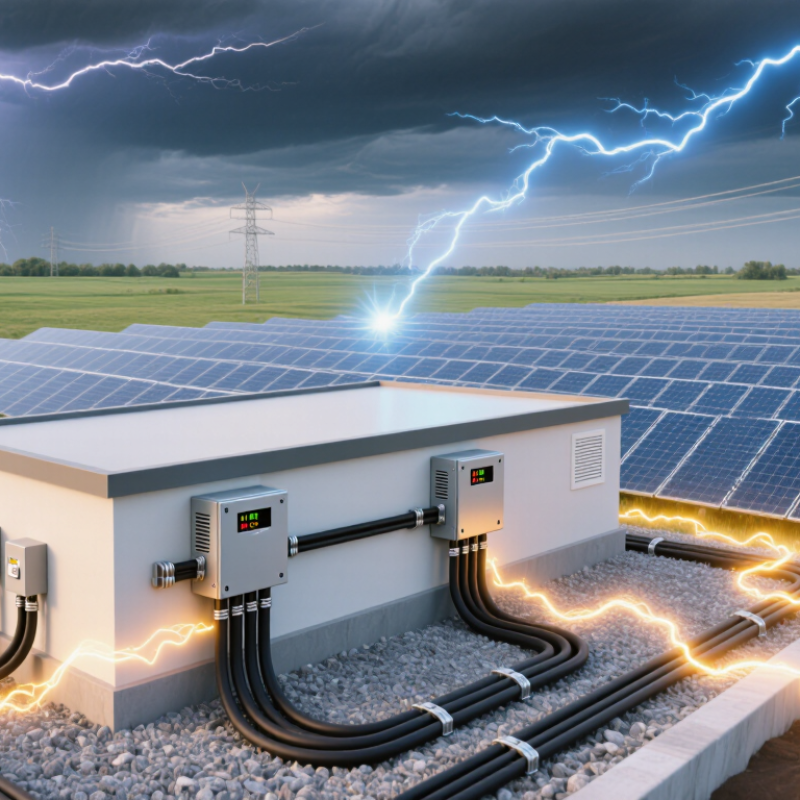
Lightning rarely strikes a solar panel directly, yet nearby bolts can still damage a grid-tied system. A strike may raise ground potential around an array within microseconds. That sudden difference drives surge current through photovoltaic cables, bonding conductors, or the utility connection. The inverter often becomes the most vulnerable point. Its switching electronics can fail silently, then stop exporting power hours later.
During field inspections, technicians may find melted connector housings, tripped protective devices, or communication faults after a distant storm. Not every failure is obvious. A system can restart normally while insulation has weakened inside a cable. That uncertainty matters. Surge protective devices should protect both the direct-current array side and the alternating-current service side. Their grounding paths must be short, straight, and properly bonded. Long loops can create damaging voltage during a fast transient.
Good protection also depends on the building and utility design. Installers should follow local electrical rules, equipment instructions, and recognized lightning-protection practices. They should verify conductor routing, grounding continuity, and protective-device status during commissioning and after severe storms. A rooftop array is not automatically a lightning rod. Adding metal equipment can change current paths around a structure. This is where assumptions fail. No protection scheme guarantees survival, but coordinated bonding, shielding, and surge diversion can reduce damage and shorten downtime.
Yes. A nearby strike can induce voltage through soil, wiring, or utility lines. Long rooftop cables may collect surge energy. The panels may look normal while internal parts fail.
Inverters often show damage first because their switching circuits are sensitive. Other failures include cracked modules, burned bypass diodes, damaged junction boxes, and failed fuses. Monitoring equipment can fail too.
It may move along positive and negative DC conductors. It can also use grounding conductors, metal frames, and utility wiring. Current may enter through the inverter and continue toward building circuits.
Grounding conductors may look intact while internal electronics have failed. A working inverter display does not prove complete protection. Diagnosis is not always clean.
Use coordinated surge protective devices on DC, AC, and service-entry circuits. Keep their cable paths short and direct. One device cannot protect every circuit.
They provide a low-resistance path for unwanted surge energy. Frames, rails, enclosures, and panels should connect continuously. Loose hardware can create dangerous voltage differences within milliseconds.
Check cable insulation, grounding connections, rooftop junctions, and inverter error logs. Look for discolored terminals and damaged protective devices. Small warning signs matter.
No. Even a compliant system can suffer during an unusually severe event. Careful protection can reduce damage and shorten downtime, but perfect protection is unrealistic.
This guide explains how does lightning affect grid-tied solar power systems and why even a nearby strike can create dangerous electrical surges. Lightning may damage solar panels, inverters, wiring, monitoring equipment, grounding paths, and utility-interconnection components. Surge currents can enter through the array, electrical grid, communication cables, or grounding system, then travel across connected equipment and cause immediate failure or hidden deterioration. The severity depends on the strike’s distance, current strength, system design, and the quality of its grounding and protection.
The article also highlights practical ways to reduce lightning-related damage, including properly installed surge protection devices, effective bonding and grounding, suitable disconnects, and carefully planned cable routing. After a suspected strike, the system should be shut down safely and inspected for visible damage, fault alerts, insulation problems, burned connections, and abnormal performance. Qualified professionals should test the equipment before reconnection, document damaged components, and complete necessary repairs to restore safe, reliable operation.

 Phlox Energy