Top Reasons Why Your Solar Combiner Box Keeps Blowing Fuses

Time:2026-09-16 Author:Oliver
0%

If you are asking, “why is my solar combiner box blowing fuses repeatedly,” the fuse is usually reporting a problem, not causing one. A repeated failure deserves careful testing. It may indicate excessive string current, a shorted module, damaged wiring, reverse polarity, or moisture inside the enclosure. Sometimes, a mismatched fuse creates trouble. A fuse rated too low can open during normal production, especially during bright midday conditions. A fuse rated too high can fail to protect the conductors properly.

John Wiles, a respected photovoltaic code expert, emphasized a practical rule: “Find the fault; do not simply replace the fuse.” That advice remains valuable in field troubleshooting. Experienced technicians isolate each string, inspect fuse holders, and compare measured current with the design values. They also look for melted plastic, darkened terminals, loose crimp connections, and water droplets beneath the box cover. Small details matter.

Do not guess.

A clamp meter can reveal an unusual string current, but testing must follow proper electrical safety procedures. The inverter should be shut down according to the manufacturer’s instructions. The array may still produce dangerous DC voltage in sunlight. This is where inexperienced repairs can become risky. We may initially blame the panels, yet the real issue could be a failed surge protector or a poorly sealed cable entry. That assumption is easy, and often wrong. A qualified solar professional should confirm polarity, insulation resistance, fuse specifications, and connector condition before installing another fuse. The goal is not merely restoring power. It is identifying why the combiner box keeps opening the circuit.
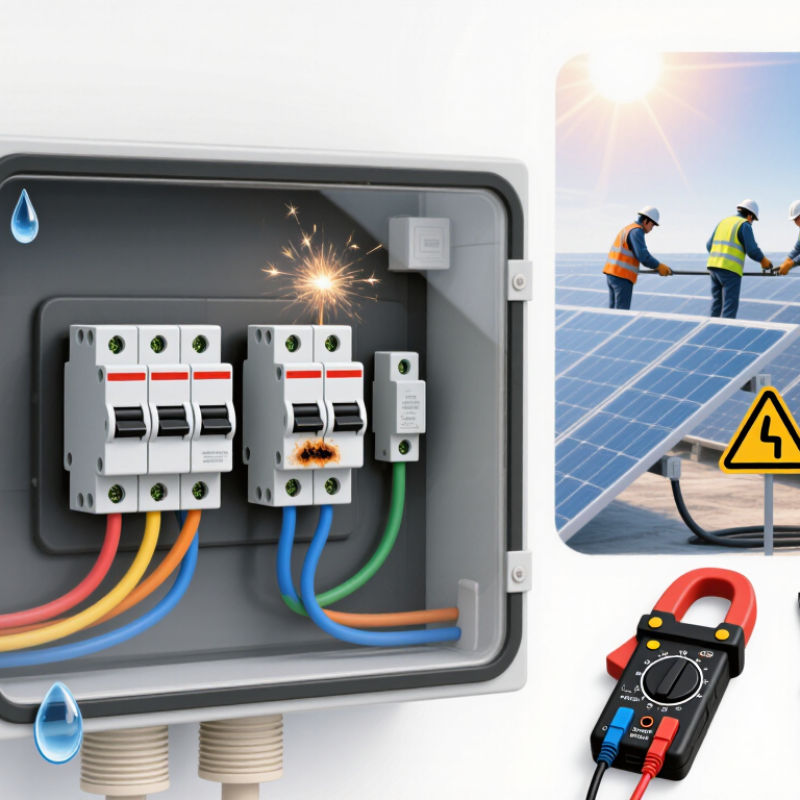
Top Reasons Why Your Solar Combiner Box Keeps Blowing Fuses

Common Functions and Components of a Solar Combiner Box

A solar combiner box gathers multiple photovoltaic strings into a safer, organized output. Its enclosure protects internal parts from dust, moisture, and accidental contact. Inside, fuse holders protect each string from excessive current. If one string develops a short circuit, its fuse should open before the wiring overheats.

The positive and negative busbars combine string conductors before power travels to the inverter. Clearly marked terminals reduce polarity mistakes during installation and maintenance. Many boxes include a DC disconnect switch, allowing technicians to isolate the array during service. Surge protection devices help divert brief overvoltages caused by lightning or switching events. Some models also provide current monitoring, which can reveal a weak or shaded string.

Repeatedly blown fuses deserve careful testing, not repeated replacement. A fuse with the wrong rating may fail too easily, while an oversized fuse can reduce protection. Loose terminals create heat; I have seen darkened plastic around a connection after months of vibration and thermal cycling. Moisture can also cause corrosion and leakage paths. Check string voltage, polarity, insulation resistance, fuse condition, and terminal torque with suitable instruments. Do not assume the box is faulty. Sometimes the real problem is damaged cable insulation, an incorrectly matched module string, or a failed surge protector. One detail is easy to miss: fuses must match the system’s DC voltage and current requirements, not merely the panel’s nominal rating.

How Overcurrent Causes Solar Combiner Box Fuses to Blow

A solar combiner box fuse blows when current exceeds its rated limit. In field inspections, overcurrent often begins with one damaged or poorly matched string. A shorted module, crushed cable, or wet connector can sharply increase fault current. Several strings may also feed more current than the fuse was designed to handle. Heat leaves clues: dark fuse holders, softened plastic, and a burnt electrical smell.

Fuse replacement alone rarely fixes the problem. It can hide the real fault. Turn off the array and follow the site’s isolation procedure before testing any circuit. A qualified technician should measure each string’s open-circuit voltage and operating current, then compare those readings with the design values. Check polarity, cable insulation, connector seating, and signs of water entry. Inspect the fuse size, voltage rating, and holder condition as well. A loose connection may create resistance and heat, while an undersized fuse may open during normal production.

The most useful test is often a string-by-string comparison under similar sunlight. One abnormal reading deserves attention. Do not install a larger fuse to stop repeated failures; that can damage conductors or create a fire hazard. I have seen troubleshooting take longer because installers assumed every blown fuse had the same cause. That assumption is risky. Weather, shading, aging modules, and recent wiring changes can produce different overcurrent paths. Record measurements before replacing parts, and review the combiner box’s design current against the actual array configuration.

Frequent Wiring, Installation, and Component Faults

Frequent fuse failures usually begin with wiring errors, not defective fuses. Loose terminals create heat, especially during strong midday production. Reversed polarity can also produce immediate overcurrent. An undersized conductor may warm slowly, while damaged insulation allows moisture into the circuit. I have seen one poorly crimped connection turn a clean junction into a dark, brittle mess. Small mistakes matter.

Installation faults often hide behind an apparently healthy combiner box. Incorrect fuse ratings can leave circuits unprotected or cause unnecessary trips. Excessive cable bending may stress terminals and loosen connections over time. Poor ventilation increases internal temperature, reducing fuse life. Water entering through an unsealed conduit is another common cause. The easy answer is often wrong. A careful inspection should include torque checks, polarity testing, insulation condition, and current measurements on each string. Component faults still occur, including cracked fuse holders, corroded busbars, and damaged surge protection devices.

Tips: Shut down the system according to the approved procedure before opening the enclosure. Use a calibrated meter and insulated tools. Compare each string’s current with nearby strings under similar sunlight. Record every reading, even when it seems normal. If one fuse repeatedly fails, replace it only after finding the underlying fault. A qualified solar technician should verify repairs, because visual checks alone can miss heat damage.

Steps to Diagnose a Repeatedly Blowing Fuse

A repeatedly blowing fuse in a solar combiner box is a warning, not a nuisance. Do not install a larger fuse. That can damage conductors or create a fire risk. Shut down the array according to the system procedure, and use insulated test equipment. Only qualified personnel should open energized enclosures.

Begin by recording which fuse failed and when it failed. A fuse that opens during bright midday sun may indicate excessive string current or a downstream short. Check the fuse rating, holder condition, and cable size against the design documents. Look for melted plastic, darkened terminals, loose screws, and moisture droplets. Small details matter. A damp connector can cause intermittent faults.

With the circuit safely isolated, test each string separately. Compare operating current and open-circuit voltage with neighboring strings. A sudden voltage difference may indicate reversed polarity, damaged modules, or a failed connector. An insulation resistance test can reveal a cable touching the frame or wet roof surface. Check for shading too, although shading alone rarely explains repeated fuse failure. Surge damage and incorrect installation can also leave hidden faults.

Keep a written test record with weather conditions and meter readings. Rushed troubleshooting often blames the fuse first, which is usually a mistake. If readings change after rain, inspect cable entries and seals again. Replace only with the specified fuse type and rating, then monitor the circuit under normal load. If the fuse opens again, stop testing and involve a licensed solar electrician.

Top Reasons Why Your Solar Combiner Box Keeps Blowing Fuses - Steps to Diagnose a Repeatedly Blowing Fuse
Diagnostic Area Typical Field Clue Most Likely Cause Recommended Diagnostic Check Corrective Action Priority
Short circuit in a PV string The same string fuse opens repeatedly, often immediately after reconnection or during strong sunlight. Damaged module wiring, crushed cable, incorrect connector assembly, or a conductor contacting the opposite polarity. With the circuit isolated by a qualified technician, inspect the complete string route and compare open-circuit voltage with similar strings under comparable conditions. Repair or replace damaged cable, connectors, or modules. Do not replace the fuse until the short-circuit source has been located. High
Ground fault A fuse opens during wet weather, after washing, or when insulation resistance decreases. Moisture ingress, damaged insulation, a pinched conductor, or a module fault connecting the circuit to ground. Use an approved insulation-resistance test method suitable for the array and equipment. Inspect junction boxes, connectors, cable glands, and conduit entries for moisture or abrasion. Remove moisture, improve sealing, and replace components with compromised insulation. Follow the applicable electrical safety procedure before testing. High
Excessive reverse current A string fuse blows when multiple parallel strings are operating, even though the affected string appears normal by itself. Current from healthy parallel strings is being forced backward into a faulted or shaded string. Compare string current and polarity. Check the number of parallel strings, array configuration, module maximum series-fuse rating, and the combiner fuse specifications. Correct the array configuration and use overcurrent protection that is permitted by the module and system documentation. Repair any faulted string. High
Incorrect fuse type or rating Replacement fuses fail more quickly than expected, or fuse bodies show overheating without a clear string fault. Fuse voltage rating, current rating, interrupt rating, or photovoltaic application class is unsuitable for the circuit. Verify the fuse marking against the system maximum voltage, expected current, short-circuit current, combiner design, and the module's permitted series-fuse rating. Install only a correctly specified photovoltaic fuse approved for the equipment. Never increase the fuse rating simply to stop nuisance failures. High
Overcurrent from an undersized fuse The fuse opens during high irradiance while string voltage and wiring appear normal. The selected fuse does not provide enough continuous-current capacity for the string's actual operating conditions and design requirements. Review the string short-circuit current, expected irradiance and temperature conditions, conductor ampacity, fuse-holder rating, and the original design calculations. Recalculate the protection scheme and correct the fuse or conductor size only within the limits of the equipment and governing electrical requirements. Medium
Loose or corroded fuse-holder connection The fuse or holder is discolored, melted, warm to the touch, or associated with intermittent trips. High contact resistance caused by loose termination, corrosion, contamination, incompatible parts, or an incorrectly seated fuse. After isolation and verification of absence of voltage, inspect terminals and compare temperature across similar fuse holders using suitable thermal inspection equipment. Replace damaged holders and terminals, clean or repair approved connections, and tighten them to the equipment manufacturer's specified torque. High
Damaged or mismatched connectors Fuse failures occur after maintenance, connector replacement, cable movement, or heavy vibration. Connectors from different mating systems, incomplete locking, poor crimping, contamination, or water entry. Inspect connector bodies, seals, locking mechanisms, and crimp areas. Check for abnormal resistance or heat at operating current using approved procedures. Replace the complete damaged connector interface with compatible parts and remake any defective crimp. Avoid mixing connector systems unless specifically approved. High
Module or bypass-diode failure One string has unusually low voltage or current, and its fuse opens repeatedly after module-level damage or shading events. Internal module short, failed bypass diode, cracked module, hot-spot damage, or water penetration. Compare the affected string with neighboring strings and inspect modules for cracks, burn marks, delamination, hot spots, or abnormal electrical readings. Replace the defective module or approved internal component. Investigate the original cause before returning the string to service. High
Incorrect polarity or reversed string connection Fuse opens immediately after a new string is connected or after wiring work. Positive and negative conductors are reversed, or a connector has been misidentified during installation or maintenance. Measure polarity at the string and combiner inputs with the circuit isolated as required. Compare labels, drawings, and terminal positions. Correct the wiring and update labels or documentation. Do not bridge or bypass the fuse while troubleshooting. High
Surge or lightning-related damage Several fuses, surge-protection components, or monitoring devices fail after a nearby lightning event or grid disturbance. Transient overvoltage has damaged a surge protective device, module, fuse holder, or associated wiring. Inspect surge-protection indicators, grounding and bonding conductors, enclosure condition, and all affected circuits for visible or measured damage. Replace damaged protective devices and components, then verify the grounding, bonding, and surge-protection design before energizing. High
Water or condensation inside the combiner box Fuse failures correlate with rain, condensation, temperature changes, or poor enclosure positioning. Damaged gasket, unsealed cable entry, blocked drain or vent, incorrect enclosure installation, or condensation buildup. Inspect the enclosure interior, gasket, cable glands, drain paths, and signs of corrosion or water tracking. Check that the enclosure rating is suitable for its location. Dry and clean the enclosure, replace seals or glands, restore drainage, and replace corroded electrical parts. High
Shading, soiling, or string mismatch Fuse operation occurs only under particular sun angles or when one string has substantially different current from the others. Unequal string design, module count mismatch, persistent shading, severe soiling, or different module electrical characteristics. Compare module count, orientation, tilt, shading pattern, short-circuit current, operating current, and open-circuit voltage among parallel strings. Correct string grouping, remove abnormal shading or soiling, and separate incompatible strings according to the system design. Medium
Conductor damage or undersized wiring Fuse or cable termination becomes hot under normal production, or failures follow mechanical work near the array. Small conductor cross-section, excessive cable length, abrasion, rodent damage, sharp bends, or poor routing that increases resistance. Inspect the entire cable path and compare conductor size, length, ampacity, voltage drop, and insulation condition with the design requirements. Repair or replace damaged conductors and correct routing, support, protection, or conductor sizing as required by the system design. High
Improper maintenance or repeated fuse replacement New fuses are installed repeatedly without documenting the failed circuit or identifying the original fault. Underlying electrical faults remain active, or fuses are replaced while the array is energized or not fully isolated. Review maintenance records, identify the exact fuse position, photograph evidence, record string measurements, and confirm isolation before replacing protection. Stop repeated replacement, perform a structured fault investigation, and use qualified personnel with appropriate arc-flash and electrical safety controls. High
Safety note: PV strings can remain energized whenever illuminated, even when the inverter or AC disconnect is off. Repeated fuse failures should be investigated by qualified electrical personnel using the system drawings, equipment ratings, and applicable local electrical requirements. Never bypass a fuse or install a higher-rated fuse without a documented design review.

Safety Measures and Preventive Maintenance Practices

Top Reasons Why Your Solar Combiner Box Keeps Blowing Fuses

Safety Measures and Preventive Maintenance Practices

Repeated fuse failures usually signal an underlying electrical fault. Common causes include loose terminals, moisture, damaged insulation, incorrect fuse ratings, and reversed polarity. A hot afternoon can expose weak connections. Thermal expansion increases resistance and may trigger another failure.

Disconnect the photovoltaic system before opening the enclosure. Follow the equipment isolation procedure. Wear voltage-rated gloves, eye protection, and arc-rated clothing when required. Never replace a fuse with a larger one. That shortcut can overheat conductors and create a serious fire risk. A qualified electrician should verify the circuit design and protective-device ratings.

Tips: Inspect cable glands for cracks and water marks. Check terminals for discoloration or melted plastic. Confirm torque values with a calibrated tool. Test insulation resistance and polarity using approved instruments. Keep the box dry and clean. Record each fuse failure, weather condition, and measured voltage. These details often reveal patterns that casual inspections miss.

Preventive maintenance should follow the installation environment and local electrical requirements. Schedule inspections after storms, flooding, or unusual shutdowns. Look for rodent damage and corrosion around the enclosure. Infrared scanning can identify hot connections before fuses fail. Still, instruments are not perfect. A normal reading may hide an intermittent fault, so repeat testing under safe operating conditions. Never bypass a fuse to “see what happens.” That experiment can turn a minor defect into extensive equipment damage.

FAQS

Why does a solar combiner box fuse keep blowing?

Repeated failures usually indicate an electrical fault, not a defective fuse. Loose terminals, moisture, damaged insulation, reversed polarity, or excessive string current may be involved.

Should I install a larger fuse?

No. A larger fuse can overheat conductors and create a serious fire risk. Use only the specified fuse type and rating.

What should I check before opening the enclosure?

Shut down and isolate the photovoltaic system according to its procedure. Use insulated test equipment and suitable protective clothing. Only qualified personnel should open energized enclosures.

What physical signs can reveal the problem?

Inspect for melted plastic, darkened terminals, loose screws, cracked cable glands, corrosion, and moisture droplets. Small clues matter.

How can I test individual solar strings?

Isolate the circuit safely, then test each string separately. Compare operating current and open-circuit voltage with nearby strings. A sudden voltage difference may indicate damaged modules or connectors.

Can rain cause repeated fuse failures?

Yes. Moisture may enter through cable entries, seals, or damp connectors. If readings change after rain, inspect those areas again. Not always obvious.

Can shading alone blow a fuse repeatedly?

Shading rarely explains repeated fuse failures by itself. Also check excessive current, surge damage, incorrect installation, cable faults, and insulation contacting a frame or wet surface.

What maintenance can prevent future fuse failures?

Inspect the enclosure after storms, flooding, or unusual shutdowns. Check terminal torque, cable glands, insulation, polarity, corrosion, and rodent damage. Infrared scanning may reveal hot connections, but normal readings can miss intermittent faults.

Conclusion

A solar combiner box collects power from multiple photovoltaic strings, combines their outputs, and uses fuses, disconnects, surge protection, and monitoring components to improve system safety. When a fuse blows repeatedly, the usual cause is excessive current or an electrical fault. This may result from damaged modules, short circuits, ground faults, mismatched string currents, incorrect fuse ratings, loose terminals, reversed polarity, poor wiring, moisture, or improper installation. In some cases, a faulty fuse holder or surge protection device can also create abnormal current paths.

If you are asking, “why is my solar combiner box blowing fuses repeatedly,” begin by shutting down the system safely and following the manufacturer’s testing procedures. Inspect cables, connectors, terminals, and enclosures for heat, corrosion, water, or physical damage. Measure each string separately, compare current and voltage readings, and check for insulation or ground faults with suitable equipment. Replace fuses only with correctly rated components, correct the underlying problem, keep connections tight and dry, and schedule regular inspections to prevent recurring failures.

Oliver

Oliver

Oliver is a seasoned marketing professional with a wealth of expertise in driving brand awareness and engagement. With a deep understanding of our company's product offerings, he consistently delivers high-quality content that enriches our professional blog. His insights not only shed light on......